
Blog
What Exactly Is a Budget-Friendly eSIM and How Does It Save You Money?

Stay Connected for Less: The Best Cheap eSIM Plans for Travelers
Imagine landing in a new country and, within two minutes, you have data on your phone without hunting for a local SIM card—that’s the magic of a cheap eSIM. It’s a digital SIM you download straight to your device, and because there’s no physical plastic to ship or store, you can grab a low-cost data plan for almost any destination before you even board the plane. To use it, just scan a QR code from a budget provider, pick a plan that fits your trip length, and switch networks instantly in your settings, all while keeping your main number intact. You only pay for what you need, making it a simple way to stay connected without the sticker shock of roaming fees.
What Exactly Is a Budget-Friendly eSIM and How Does It Save You Money?
A budget-friendly eSIM is a digital SIM card sold at a steep discount, often for a fraction of local carrier rates, by offering data-only plans on regional networks. Instead of paying per-day roaming fees, you buy a prepaid data package—like 5GB for 30 days—for a set price. It saves you money because there are no physical cards, shipping costs, or activation fees, and these plans skip postpaid overage charges. For a cheap eSIM, you only https://baztel.co/ pay for the data you actually need, and you can compare prices instantly online. Since it installs via a QR code, you avoid surprise bills, and you can top up only when required, making it the most cost-effective way to stay connected internationally.
Understanding the tech behind the savings: no plastic, no roaming charges

An eSIM replaces the physical plastic SIM card with a digitally embedded profile, eliminating manufacturing and shipping costs that carriers pass onto consumers. This also removes the need for physical SIM swapping when traveling, instantly connecting to local networks via software. Roaming charges disappear because the eSIM downloads a local carrier’s profile, routing your traffic through that regional network at domestic rates. You avoid the carrier’s international markup by purchasing a data-only plan directly from a budget eSIM provider. The technical shift to remote provisioning is what enables this price drop, as no physical logistics or bilateral roaming agreements inflate your bill.
A cheap eSIM saves money by replacing plastic with digital profiles and using local network access to bypass roaming fees entirely.
Where the real cost difference comes from compared to physical SIM cards
The real cost difference comes from eliminating physical distribution and logistics—a plastic SIM card requires manufacturing, packaging, shipping, and retail shelf space. With an eSIM, all of that vanishes; the carrier just sends a QR code or profile to your phone, so the overhead is nearly zero. That savings gets passed to you directly in lower plan prices, especially for travel data. Skip the airport booth markup and the hassle of buying a local SIM—your phone downloads the plan instantly, often at 30–60% less per gigabyte, because you are buying purely data, not a physical product chain.
You pay less because there’s no plastic, no packaging, no shipping—just a digital profile, and carriers pass those logistics savings straight to your wallet.
How to Find the Absolute Cheapest Data Plans Without Sacrificing Coverage
To secure the absolute cheapest eSIM without losing signal, start by comparing plans on regional aggregators like esimdb or CompareCellular, filtering specifically for your destination’s primary network bands. Prioritize providers that lease access to major local towers—like Airalo’s “Discovery” or Holafly’s “Global”—because smaller MVNOs often throttle to dead zones, which voids the savings. A trick is to buy a “regional” eSIM (covering multiple countries) instead of single-country plans; per-GB costs drop by 40% to 60% while the same core networks handle routing. Paying $3 for 1GB is worthless if you reconnect to a weak carrier every hour, so check the fine print for “network partner” names. Finally, use referral codes from travel forums or cashback apps—these slice another 10–15% off your checkout, and always test the eSIM’s coverage map before purchasing to confirm your route isn’t in a gray zone. Only ever buy from providers with a free cancellation window, so you can refund instantly if signal drops during your first day.
Comparing per-gigabyte prices across providers for short trips
For short trips, comparing per-gigabyte prices across providers requires converting each short-term package into a single cost-per-GB metric, rather than focusing on the total upfront fee. A 5 GB plan for $12 yields $2.40/GB, while a 3 GB plan for $9 yields $3.00/GB, making the former cheaper even if the absolute price is higher. Filter regional or global eSIM catalogs by duration that matches your travel days, then divide the price by included data. Short-trip per-gigabyte cost analysis matters because low-usage travelers often overpay for unused data—a 1 GB plan at $6 is less efficient than a 2 GB plan at $8 if your actual consumption is 1.2 GB. Cross-check on comparison sites that show normalized GB rates for 7- and 14-day validity windows.
| Provider | Data | Price | Cost per GB |
|---|---|---|---|
| Plan A | 3 GB / 7 days | $9 | $3.00 |
| Plan B | 5 GB / 10 days | $11 | $2.20 |
| Plan C | 1 GB / 5 days | $5 | $5.00 |

Hidden fees to watch out for that make a “low price” actually expensive
A rock-bottom eSIM price tag can hide sneaky costs that erase your savings. Watch for hidden fees that inflate a cheap eSIM plan—like a one-time “activation fee” that appears only at checkout. Also, check if the quoted rate applies just for the first billing cycle, then jumps after a “promo period.” Some plans tack on “service charges” for top-ups or force you to buy a minimum data bundle you never use. Finally, read the fine print for “inactivity fees” if you don’t use data for a month, or a surprise “refund processing fee” if you cancel. Always calculate the real cost per GB, including these extras, before you buy.
Step-by-Step: Setting Up Your Low-Cost Digital SIM in Under Five Minutes
You grab your phone, unlock it, and open the settings—no plastic tray, no tiny SIM card, just a cheap eSIM waiting in your email. The first step is scanning the QR code your provider sent, which takes ten seconds, and your device instantly downloads the digital profile. Next, you label it “Travel Data” to keep it separate from your home number, then toggle cellular data to that new line—no need to remove your physical SIM. Within two minutes, you’re connected, paying pennies per megabyte instead of roaming rates. The entire setup hinges on a stable Wi-Fi connection, so do it at home or a café before you board.
Once the profile is saved, switching between your regular SIM and this cheap eSIM is just a tap in your settings, making the whole process feel like a quiet power move against expensive carriers.
Finally, you test a speed check, confirm the data arrow blinks, and close your bag—under five minutes, zero stress, and your trip starts with money still in your pocket.
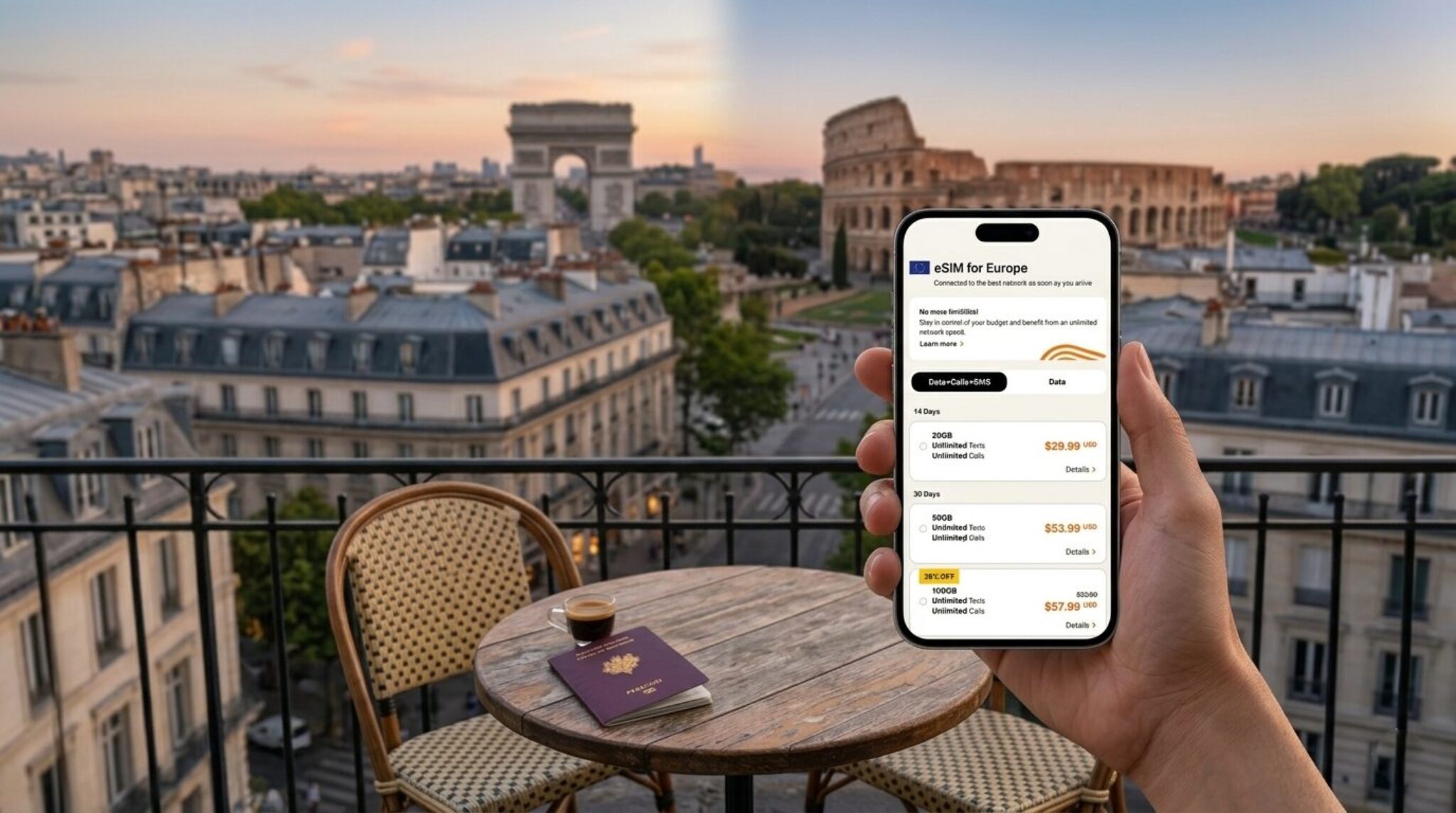
Checking phone compatibility before you buy anything
Before purchasing any cheap eSIM, verify your device supports eSIM functionality, as not all phones do. Check your model’s specifications on the manufacturer’s website or dial `*#06#`—if an EID number appears, your phone is eSIM-ready. Additionally, confirm your device is unlocked for international carriers, since a locked phone may reject a foreign eSIM profile. Also, ensure the eSIM’s network bands match your phone’s supported frequencies, especially for older budget models. Finally, check if your phone allows multiple eSIM profiles, as some low-cost plans require switching. Skipping these checks can waste money on an incompatible digital SIM.
Scanning, installing, and activating—no store visit required
For a cheap eSIM, the entire process hinges on scanning, installing, and activating—no store visit required. After purchasing, you receive a QR code via email; scan it with your phone’s camera to download the eSIM profile directly. Installation takes less than a minute, as the system auto-configures the APN settings, eliminating manual input. Next, activate the line by toggling it on in your cellular settings—often, the profile activates immediately upon connection to a local tower. This instant digital provisioning is the core advantage of budget eSIMs, allowing you to bypass physical retail entirely. The zero-footprint activation flow ensures that even a $5 plan is live within five minutes, provided your device is unlocked and eSIM-compatible.
Smart Tricks to Stretch a Tiny Data Allowance Further on a Tight Budget
With a cheap eSIM, every megabyte counts, so start by disabling background app refresh and auto-play videos in your settings—these silently eat data. Use the eSIM’s native offline maps feature to navigate without a connection, and compress browsing with a lite-mode browser. When streaming, drop quality to 144p or download music over Wi-Fi before you leave the house. Also, force your phone to prefer Wi-Fi calling and turn off iMessage/WhatsApp photo auto-downloads. Think of your eSIM as a ration pack, not a buffet. Q: What’s the fastest way to halve usage? A: Switch your eSIM data plan to “low data mode” and pre-load your daily commute’s route while connected to free Wi-Fi.
Turning off background app refresh and auto-downloads
With a cheap eSIM’s tiny data allowance, background app refresh and auto-downloads silently drain megabytes even when you’re not looking. Disable background refresh for social media, email, and news apps in your phone’s settings so they only fetch new content when you open them. Turn off automatic app updates, podcast downloads, and iCloud/Google Photos backups over cellular, restricting these to Wi-Fi only. For a logical sequence: first, open Settings and toggle off background refresh globally or per app; second, switch app store auto-updates to “off” or “Wi-Fi only”; third, disable auto-play videos in streaming and social apps. *A single 15-second video auto-playing can consume more data than ten text-heavy web pages.* Finally, check each app’s internal download settings, as many have separate toggles for media preloading.
Using offline maps and Wi-Fi hotspots to make 1GB last a week
With a cheap eSIM’s 1GB allowance, aggressively pre-download offline maps for your entire route, city, and transit zones while on Wi-Fi, then switch the eSIM’s data off during navigation. Strategic Wi-Fi hotspot hopping—at cafés, libraries, and hotel lobbies—lets you batch-load email, messaging, and map updates, silencing background app refresh. Reserve your eSIM’s megabytes strictly for real-time needs like ride-hailing or live traffic. *The discipline of checking a map before leaving a hotspot turns a 1GB plan into daily, dependable city navigation without a single wasteful megabyte.* Pair this with offline translation packs and pre-cached web pages; your phone becomes a location-aware tool that barely touches cellular data, stretching that gigabyte across seven full days.
Regional Picks: Where the Best Value Plans Are Right Now by Destination
For regional picks on cheap eSIM value, Europe’s multi-country plans dominate—think a 30-day, 10GB pass covering France, Italy, and Spain for under $20, beating local SIMs on hassle. Asia’s sweet spot is Southeast Asia, where a single regional eSIM for Thailand, Vietnam, and Malaysia drops below $15 for 15GB, ideal for hop-on travelers. Meanwhile, the Middle East pairs UAE and Saudi in one 5GB plan near $12, while Latin America’s best buy stacks Mexico and Colombia at 8GB for $18. Always check coverage density, not just price—some “regional” plans throttle on secondary networks.
For back-to-back short trips, a 15-day regional pass across three neighboring countries consistently saves 30–40% versus buying separate local eSIMs.
Top affordable options for Europe, Asia, and the Americas
For top affordable eSIM options across Europe, Asia, and the Americas, start with regional plans rather than global ones. In Europe, Airalo’s Eurolink offers 10GB for roughly $25, valid 30 days across 39 countries, while Holafly’s unlimited daily pass suits short trips. For Asia, Nomad’s Japan or Thailand packs drop below $1.50 per GB, and Ubigi’s Japan-only plan is reliable on local networks. In the Americas, Claro’s prepaid eSIM via ShopLatinAmerica covers Mexico and Brazil cheaply, while US Mobile’s light plan at $10 for 2GB works for stateside visits. Always check your phone’s band support before buying, as some regional packs omit certain carrier frequencies.
- Europe: Airalo Eurolink (10GB/$25) or Holafly daily pass for multi-country trips.
- Asia: Nomad Japan/Thailand (under $1.50/GB) or Ubigi for single-country stays.
- Americas: Claro regional prepaid for Latin America; US Mobile light plan for US/Canada.
Why some countries have ultra-low local rates you can tap into
Some destinations offer shockingly cheap local eSIM data because their telecom operators price for massive domestic volume, not international profit margins. In places like India, Turkey, or Indonesia, intense carrier competition and low income-adjusted costs push per-gigabyte prices down to pennies, and you tap into those rates by buying a regional or local eSIM directly instead of a global roaming pass. These ultra-low local rates often include 5G and large data buckets, making them perfect for streaming or hotspotting. The catch is that coverage may prioritize city density, so rural travel might drop to slower speeds. For high-consumption trips, local-rate eSIM plans deliver unmatched savings without requiring a physical SIM swap.
The Real Deal on Validity, Top-Ups, and Getting a Refund If Something Fails
With cheap eSIMs, validity windows are often shorter than advertised—many budget plans list a 30-day expiration but count activation, not purchase, as day one. Top-ups involve buying a new data package rather than extending the current one, and cheap eSIM providers rarely auto-refill; you must manually reinstall a QR code or enter a new activation code. Refund policies are the real catch: most budget carriers only issue refunds if the eSIM was never installed, not for coverage failures or slow speeds. If something fails after installation—like no network signal—you’ll typically be offered a prorated credit, not cash back. Always test the eSIM within the first 24 hours; many cheap eSIMs have a 24-hour grace period for full refunds, but only if you contact support before the data is touched. Read the refund clause before buying.
What happens when your travel dates change or the data runs out early
When your travel dates shift, most cheap eSIM plans activate on first connection, so a delayed trip doesn’t pause the clock—your validity burns regardless. If you land late or leave early, you lose unused days with no prorated credit. Conversely, if your data runs out early, you cannot extend the existing plan; you must buy a separate top-up, which often costs more per GB than the original bundle. Some providers let you re-purchase the same plan for a new period, but refunds for the unused portion are almost never issued—validity starts at first use, not your intended schedule. Check the activation policy before buying to avoid paying for days you never use.
Shifted dates waste remaining validity, and early depletion forces a pricier top-up—refunds for unused time are rare, so plan around first-connection activation.
How to buy again on the same profile without paying a new activation fee
To avoid a new activation fee on your next trip, re-purchase a data package directly onto your existing eSIM profile instead of deleting it and starting over. Open your provider’s app or website, log in, and select “Top Up” or “Buy Data” for the same profile—this bypasses the QR-code re-installation cost. Ensure your current plan is fully expired or set to auto-renew, then choose a fresh package from the list. Crucially, never remove the profile from your phone’s settings, as re-adding it triggers a fee. Follow this sequence:
- Check your profile’s status under “My eSIMs” in the app.
- Hit “Add Data” and confirm the same profile number.
- Pay only for the data, not the activation—your IMEI stays locked to the plan.